
The method is ordinary. The discipline is where projects are won.
Nothing below is novel — it is close to what Microsoft's own implementation guidance recommends. What separates a system people use from one they abandon is whether a partner actually holds the line on it when a deadline gets tight.
Four phases, and we stay past the fourth.
Each phase ends with something you can review, challenge and sign — not a status percentage.
Discover
Process walkthroughs with the people who do the work, not only the people who sponsor the project. Data quality profiling on your real records. Licence and environment review. Integration inventory.
2–3 weeksDesign
Solution architecture, Dataverse data model, security and sharing model, integration design, reporting design and a governance model. Reviewed with your IT and signed off before build starts.
2–4 weeksBuild & validate
Two-week sprints, each ending in a working environment your users open themselves. Migration rehearsed at least twice with reconciliation. UAT scripts written with your users, executed by them.
6–16 weeksAdopt & evolve
Role-based training, hypercare at the desk, adoption metrics reviewed monthly against a baseline, then a quarterly release cadence that keeps up with Microsoft's two waves a year.
Ongoing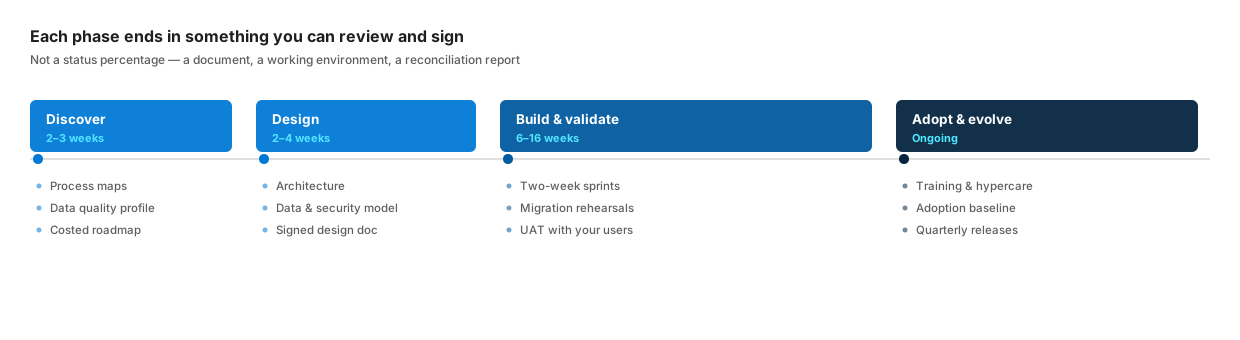
What you actually receive, phase by phase.
- Discovery report
- Current-state process maps, a prioritised gap list, a data quality assessment with record counts and defect rates, a licence position and cost model, and a costed roadmap sequenced by return. Yours to keep whether or not you continue with us.
- Solution design document
- Entity relationship model, security roles and business unit structure, integration interface specifications, environment and ALM strategy, and reporting design. Enough detail that another developer could build from it.
- Sprint demonstrations
- A working environment at the end of every sprint, with a demo script and a decision log. Requirements change in the demo, not in a change request three months later.
- Migration reconciliation
- Row counts, exception reports, and a business sign-off per entity before go-live. Plus a documented rollback that we have actually tested.
- Handover pack
- Managed solutions, source-controlled configuration, admin runbook, integration credentials inventory, and a documented environment strategy. Delivered as standard, not billed as an extra.
- Adoption baseline
- Agreed usage and outcome metrics captured before go-live, then reported monthly. Without a baseline, "adoption is improving" is an opinion.
The engineering discipline that keeps change cheap after year one.
Most of what makes an inherited Dynamics environment expensive to change was decided in the first month of its original build, by someone under time pressure who thought it would not matter.
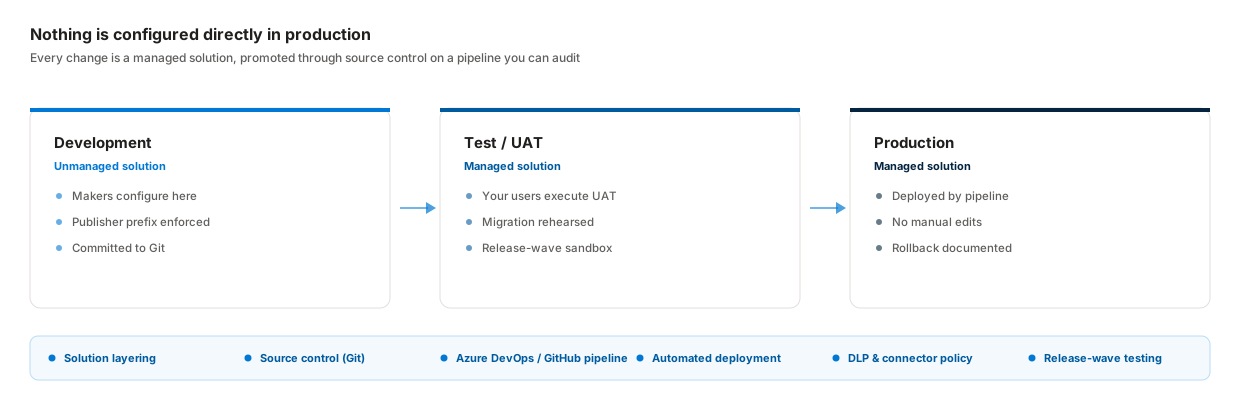
- Environment strategySeparate development, test and production, with an agreed promotion path. No configuring directly in production, ever.
- Managed solutions and layeringPublisher prefix, solution segmentation and dependency discipline, so components can be removed as cleanly as they were added.
- Source control and pipelinesConfiguration in Git, automated deployment through Azure DevOps or GitHub. A release should be boring.
- Configure first, code only when justifiedCustom code is a liability with a maintenance cost. We write it when the platform genuinely cannot express the requirement, and we document why.
- Release wave readinessMicrosoft ships two major waves a year. We test them against your environment in a sandbox before they reach your users, not after.
- Data loss prevention and tenant policyConnector policies, environment maker roles and sharing limits agreed with your IT before citizen development spreads.
Three ways to work with us. All of them priced before you commit.
Fixed-scope package
A defined outcome for a defined price: a discovery workshop, a single-module deployment, an accelerator fit, a health check on an inherited environment. You know the number before you commit the budget.
Best when you need a first result to justify a larger programme.
Programme delivery
Multi-module, multi-phase rollouts with a named architect, a delivery lead and a steering cadence. Scope managed sprint by sprint against a roadmap agreed at the start.
Best when several business units go live over twelve to eighteen months.
Managed support & evolution
Tiered support with defined response targets, a monthly enhancement allowance, release wave testing, licence optimisation reviews and a named consultant who knows your environment.
Best when you have a live system and no internal Dynamics capability — or want to build one.
Things you would find out eventually.
- We do not resell licences at a markup
- Buy from Microsoft or your CSP. We will advise on the cheapest compliant configuration, including cases where a Power Apps licence covers what you were about to buy a Dynamics 365 licence for.
- We work in Customer Engagement, not Finance or Business Central
- Sales, Customer Service, Field Service, Customer Insights, Dataverse and Power Platform. For ERP we integrate to your existing platform or work alongside your ERP partner. We would rather be excellent at one half than adequate at both.
- We will tell you when the answer is not Dynamics
- Sometimes the problem is process, or data, or a much smaller tool. Recommending a platform that will not pay for itself buys us one project and costs us a reference.
- The person who scopes it is the person who builds it
- No offshore handover after signature, no account manager relaying questions. The team is small deliberately.
- Everything is built to be handed over
- Managed solutions, documentation, source control, admin runbook. If you take the system in-house or move partners, it transfers cleanly. We would rather earn the renewal than hold the keys.
- We take over other partners' work
- Health check first — architecture, solution layering, data quality, licence position and technical debt — with a written remediation plan and a cost. Then you decide.
Begin with discovery. Keep the roadmap either way.
Two to three weeks, fixed price. Process maps, a data quality assessment, a licence position and a costed roadmap. If you take it to another partner, it still works — that is the point.